Photo: Jacob W. Frank, Public domain · Wikimedia Commons
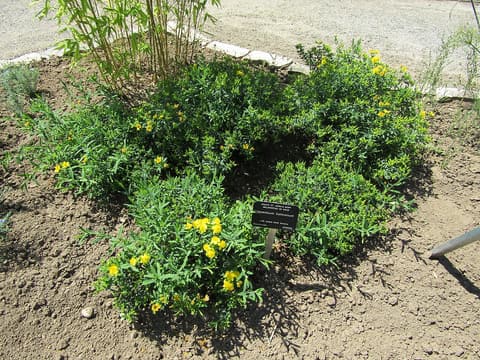
Shrubby Cinquefoil
Scientific name: Dasiphora fruticosa · Family: Rosaceae (rose family)
Also called bush cinquefoil, shrubby potentilla, Potentilla fruticosa, Dasiphora floribunda.
A low, rounded native shrub of northern fens and rocky shores whose bright yellow flowers open from June until frost.
Be first when shrubby cinquefoil is priced
Saplings ship bare-root or in a pot, usually 12 to 18 inches tall, in the dormant season, and their height and age are stated here with the price, once available.
We grow it as saplings and seed. One email when it is listed with prices, and nothing else. Or ask, and we reply with what is ready now. Live plants ship February to May and October to November.
Limited timeSign up now and get 10% off when it is ready.
Share: copy link
Shrubby Cinquefoil at a glance
- Type
- Shrub
- Mature height
- 1–4 ft
- USDA zones
- 2–7
- Growth rate
- Medium
- Flowers
- June to September
- Fruit
- Seeds, September to November
- First crop
- —
- Mature spread
- 5 ft
- Sun
- Full, Part
- Soil moisture
- Dry, Average
- Grows wild in
- Rocky ground, stream banks, the coast, swamps and wet flats
- Native range
- Alaska and 28 other states, north to North Dakota, south to Arizona and west to Oregon Also recorded, not native, in North Carolina. See what is native in your state
List all 29
Alaska, Arizona, California, Colorado, Connecticut, Idaho, Illinois, Indiana, Iowa, Maine, Massachusetts, Michigan, Minnesota, Montana, Nevada, New Hampshire, New Jersey, New Mexico, New York, North Dakota, Ohio, Oregon, Pennsylvania, South Dakota, Utah, Vermont, Washington, Wisconsin and Wyoming
Shrubby cinquefoil is a low, twiggy shrub of the cold North, wild across Canada, Alaska and the northern states and south in the western mountains. Most shrubby cinquefoils sold in garden centers are among more than 150 named cultivars, many bred from European, Asian and western American plants. Wild North American plants carry flowers with both male and female parts, while those of northern Europe are mostly male or female plants. Our saplings and seed are of the wild species, not a named cultivar. Iowa lists it as threatened. It serves well for erosion control. Set it along a sunny walk or in a rock garden, where it flowers for months.
Size, growth and what to expect
Shrubby cinquefoil grows at a medium pace, 6 inches to a foot a year in our growth estimator. It makes a dense, rounded shrub 1 to 4 feet tall and 3 to 5 feet wide, and its older bark sheds in thin strips. On moist marl sites in New York, the oldest plant studied was 36 years old, and one at the Arnold Arboretum had grown there 65 years by 1955. Each leaf is cut into three to seven narrow leaflets, usually five, which give the plant its name.
Bright yellow flowers about an inch across open from June into September, a few at a time over the whole season. In a two-year trial, the wild species drew more bumble bees and leafcutter bees than its cultivars 'Goldfinger' and 'Pink Beauty'. Butterflies visit the flowers too.
It grows wild across Canada and Alaska and south through the western mountains to New Mexico and California. In the East it reaches from Maine to Minnesota and south to New Jersey, Ohio and Illinois. There it grows in fens fed by limy groundwater, in wet meadows and on rocky shores.
How to grow Shrubby Cinquefoil
Shrubby cinquefoil flowers best in full sun and takes part shade. It grows in sand, loam or clay, limy or acid, and once rooted it stands drought and road salt. In the wild it grows in fens, often on hummocks, but in a garden it wants soil that drains and never stands in water. It does poorly in the hot, humid summers of the Southeast. Set plants 3 feet apart and keep them 3 feet from a wall. At its size it can go within 15 feet of overhead wires.
Saplings ship bare-root or potted. Plant them in a hole wider than the roots and no deeper. Set the crown at the soil line, put the native soil back in, and keep the mulch clear of the stems. Seed needs no treatment, though it sprouts less after months in storage. Sow it on damp soil in spring. Seedlings come up within four weeks.
Water it every day for the first two weeks after planting, then every two to three days until week 12. After that, water weekly through the first two summers. In late winter or early spring, take out a third of the oldest stems to keep it dense. When it grows ragged with age, cut every stem to the ground to renew it.
Each flower carries both male and female parts, so there are no male and female plants to pair. Spider mites can be troublesome in hot weather, and leaf spots and mildew trouble it where summers are humid. The small, hairy seeds ripen in fall and hang on through winter.
Heights and zones are typical ranges for the species in cultivation; local conditions and seed source shift them.
Sources (15)
- NC State Extension Gardener Plant Toolbox: Dasiphora fruticosa
- Lady Bird Johnson Wildflower Center: Dasiphora fruticosa
- The Morton Arboretum: Shrubby cinquefoil
- Flora of North America, vol. 9: Dasiphora fruticosa (Barbara Ertter and James L. Reveal)
- Trees and Shrubs Online: Dasiphora fruticosa, from Bean
- Native Plant Trust, Go Botany: Dasiphora floribunda
- Minnesota Wildflowers: Dasiphora fruticosa
- New York Natural Heritage Program: Rich Graminoid Fen, Rich Shrub Fen and Marl Fen guides
- Ricker, Lubell and Brand 2019, Comparing Insect Pollinator Visitation for Six Native Shrub Species and Their Cultivars, HortScience 54(11)
- Bonde 1965, Further Studies on the Germination of Seeds of Colorado Alpine Plants, University of Colorado Studies, Series in Biology 18
- NatureServe Explorer: Dasiphora fruticosa
- Iowa Administrative Code 571, chapter 77, Endangered and threatened plant and animal species
- USDA NRCS PLANTS Database: Dasiphora fruticosa
- USDA Forest Service, Fire Effects Information System: Dasiphora fruticosa, Anderson 2001
- Arnold Arboretum: Arnoldia 15(8), 1955, Potentilla fruticosa, a common but little known plant
Plan the planting
Check your site for it What to plant with it How big, how fast How much to water How to sow it How many for a crop When it flowers and fruits When to plant it where you live How far from the house and wires How old is yours
Read before planting
- Ten planting mistakes that quietly kill trees
- Transplanting young trees: timing, water and protection
- Protecting young trees from voles, rabbits, deer and squirrels
- Nativars or straight species: what wildlife gets from each
- The habitat around a tree is part of the tree
- What a young tree looks like: first-year seedlings of oak, walnut, hickory, chestnut, maple and redbud, and the weed trees to pull
Grows in the same conditions
Plants that share its sun and soil
Trees to plant it under: Northern White Cedar, Atlantic White Cedar and Rock Elm.
More like this