Photo: BotBln, CC BY-SA 3.0, cropped · Wikimedia Commons
Witch Hazel
Scientific name: Hamamelis virginiana
Also called common witch-hazel, American witch-hazel.
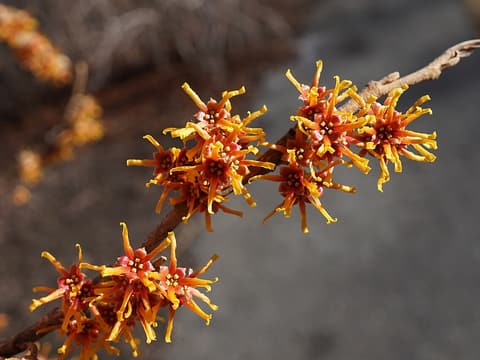
The last flower of the year: ribbon-like yellow blooms in November as the golden leaves fall.
Be first when witch hazel is priced
Saplings ship bare-root or in a pot, usually 12 to 18 inches tall, in the dormant season, and their height and age are stated here with the price, once available.
We grow it as saplings and seed. One email when it is listed with prices, and nothing else. Or ask, and we reply with what is ready now. Live plants ship February to May and October to November.
Limited timeSign up now and get 10% off when it is ready.
Share: copy link
Witch Hazel at a glance
- Type
- Shrub
- Mature height
- 12–20 ft
- USDA zones
- 3–8
- Growth rate
- Medium
- Flowers
- October to December
- Fruit
- Capsules, September to October
- First crop
- At least 6 years (first flowers)
- Mature spread
- 20 ft
- Sun
- Full, Part, Shade
- Soil moisture
- Average
- Grows wild in
- The forest understory, rich moist slopes and stream banks
- Native range
- 33 states and the District of Columbia, north to Minnesota, south to Florida and west to Texas See what is native in your state
List all 34
Alabama, Arkansas, Connecticut, Delaware, Florida, Georgia, Illinois, Indiana, Iowa, Kentucky, Louisiana, Maine, Maryland, Massachusetts, Michigan, Minnesota, Mississippi, Missouri, New Hampshire, New Jersey, New York, North Carolina, Ohio, Oklahoma, Pennsylvania, Rhode Island, South Carolina, Tennessee, Texas, Vermont, Virginia, West Virginia, Wisconsin and the District of Columbia
Native witch hazel blooms in late autumn, sometimes into December, and its seed capsules fire seeds up to 30 feet the following fall. It is a large, vase-shaped shrub or small tree of moist woods, fine in deep shade, with dependable yellow fall color. The source of witch hazel extract. After the leaves drop, the yellow flowers stay on the bare twigs into early winter. Good for an understory screen under maples, or beside a path you still walk in November.
Size, growth and what to expect
Witch hazel flowers in late fall, from October into December, with fragrant yellow blooms of four crinkled, ribbon-like petals a half to three quarters of an inch long. It grows at a medium pace, roughly a foot and a half a year in its youth on an average site, which is the rate our growth estimator uses for it. Plan on a dense, multi-stemmed clump 12 to 20 feet tall and 15 to 20 feet wide, though wild plants commonly run 15 to 25 feet. Seedlings do not flower until they are at least 6 years old.
The woody capsules ripen the next fall and burst to fling two shiny black seeds 10 to 20 feet, rarely 40. Grouse, bobwhite, pheasant and turkeys eat the seed, and deer browse the leaves. The name comes from the Anglo-Saxon wych, to bend, because settlers cut dowsing rods from its forked branches.
It grows wild from Nova Scotia and the Great Lakes south to the Florida panhandle and east Texas, most abundant in moist woods and bottoms, where it sometimes forms a solid understory.
How to grow Witch Hazel
Witch hazel is at home under taller trees but takes anything from deep shade to full sun in ordinary drained soil; more sun gives a fuller plant and heavier bloom. It grows nearly as wide as it is tall, so allow 10 feet from a building and between plants.
Plant bare-root or potted plants while dormant, in a hole twice the root width and no deeper, crown at the soil line, native soil back in, mulch off the stems. Seed needs a warm summer and then a cold winter before it sprouts: sow it outdoors in fall an inch deep, screen the bed from mice and expect seedlings the second spring.
Water it weekly through the first summer. Deer browse witch hazel and rabbits nip stems, so cage it for two or three years. It needs no pruning; shape it, if at all, in early spring after the flowers fade, since next fall's buds form in summer.
Witch hazel sets little or no seed with its own pollen, so plant two or more seedlings from different parents. Even in wild stands, fewer than one flower in a hundred sets fruit. New plants settle in slowly and may add little for a year or two. The November flowers are easy to miss when the leaves hang on around them. Cone galls on the leaves and spiny galls on twigs come from aphids and are harmless.
Heights and zones are typical ranges for the species in cultivation; local conditions and seed source shift them.
Sources (13)
- USDA Fire Effects Information System: Hamamelis virginiana
- USDA Forest Service, Plant of the Week: American witchhazel
- NC State Extension Gardener Plant Toolbox: Hamamelis virginiana
- USDA Forest Service, Woody Plant Seed Manual (2008), Hamamelis chapter, Barbour and Brinkman
- Lady Bird Johnson Wildflower Center: Hamamelis virginiana
- NatureServe Explorer: Hamamelis virginiana, American Witch-hazel
- Go Botany, Native Plant Trust: Hamamelis virginiana
- Trees and Shrubs Online: Hamamelis virginiana, from Bean's Trees and Shrubs Hardy in the British Isles
- USDA NRCS PLANTS Database: Hamamelis virginiana
- The Morton Arboretum: common witch-hazel
- Flora of North America, vol. 3: Hamamelis virginiana
- Native Plant Network propagation protocol: Hamamelis virginiana, Davis, King and Kujawski 2002, USDA NRCS National Plant Materials Center
- Anderson and Hill 2002, Many to flower, few to fruit: the reproductive biology of Hamamelis virginiana (Hamamelidaceae), American Journal of Botany 89: 67-78
Plan the planting
Check your site for it What to plant with it How big, how fast How much to water How to sow it How many for a crop When it flowers and fruits When to plant it where you live How far from the house and wires How old is yours
Read before planting
- Ten planting mistakes that quietly kill trees
- Transplanting young trees: timing, water and protection
- Protecting young trees from voles, rabbits, deer and squirrels
- What to plant under a big tree: native shrubs for shade, and how to plant without hurting the tree
- Native trees for insects: the beetles, wasps, cicadas and fireflies that everything else eats
- The habitat around a tree is part of the tree
Other witch hazels (Hamamelis) we grow: Bigleaf Witch Hazel and Ozark Witch Hazel.
Grows in the same conditions
Plants that share its sun and soil
Trees to plant it under: Florida Maple, Slippery Elm and Black Maple.
More like this