Photo: Fungus Guy, CC BY-SA 3.0, cropped · Wikimedia Commons
Common Juniper
Juniperus communis
Also called ground juniper, dwarf juniper, prostrate juniper, old field juniper, Canadian juniper.
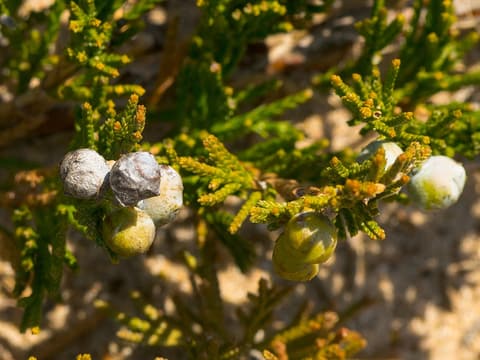
A hardy, spreading evergreen shrub with sharp, silver-banded needles in threes and blue berrylike cones, for poor, dry, sunny ground.
Be first when common juniper is priced
Saplings ship bare-root or in a pot, usually 12 to 18 inches tall, in the dormant season, and their height and age are stated here with the price, once available.
We grow it as saplings and seed. One email when it is listed with prices, and nothing else. Or ask, and we reply with what is ready now. Live plants ship February to May.
Limited timeSign up now and get 10% off when it is ready.
Share: copy link
Common Juniper at a glance
- Type
- Shrub
- Mature height
- 2–10 ft
- USDA zones
- 2–9
- Growth rate
- Slow
- Flowers
- April to May
- Fruit
- Berrylike cones, August to October
- First crop
- About 10 years
- Mature spread
- 12 ft
- Sun
- Full
- Soil moisture
- Dry, Average
- Grows wild in
- Rocky ground, sandy barrens, dry uplands, old fields and edges
- Native range
- Alaska and 39 other states, north to North Dakota, south to Georgia and west to Oregon See what is native in your state
List all 40
Alabama, Alaska, Arizona, California, Colorado, Connecticut, Delaware, Georgia, Idaho, Illinois, Indiana, Iowa, Kentucky, Maine, Maryland, Massachusetts, Michigan, Minnesota, Montana, Nebraska, Nevada, New Hampshire, New Jersey, New Mexico, New York, North Carolina, North Dakota, Ohio, Oregon, Pennsylvania, Rhode Island, South Carolina, South Dakota, Utah, Vermont, Virginia, Washington, West Virginia, Wisconsin and Wyoming
Common juniper is the most widespread conifer in the world, a low, spreading evergreen of dry, rocky hillsides, dunes and old pastures across the North. In the East it is mostly a broad, vase-shaped shrub a few feet tall. It differs from our creeping juniper in its sharp needles, set in threes, which never turn to scales. Its berrylike cones flavor gin. Illinois, Kentucky and Ohio list it as endangered, and Indiana and North Carolina list it as threatened. It helps hold the soil against erosion. Use it as a tough evergreen ground cover on a sunny, rocky bank or poor, sandy soil.
Size, growth and what to expect
Common juniper grows slowly, about a foot a year in our growth estimator. It makes a shrub 2 to 10 feet tall and 8 to 12 feet wide, and its trailing branches can root where they touch the ground. Plants can live more than 170 years. Its needles turn bronze in late summer and through winter.
Tiny cones open in April and May. On female plants, the berrylike cones take two or three years to turn from green to dark blue-black with a pale bloom. They ripen from August to October and stay on the plant for two years. Robins, chickadees, waxwings and wild turkeys eat them, and birds spread the seed.
It grows wild from Alaska to Newfoundland and Greenland, south through New England to the mountains of the Carolinas. It reaches west through northern Illinois, Indiana, Ohio, Minnesota and Nebraska to the mountains of Washington, California, Arizona and New Mexico.
How to grow Common Juniper
Common juniper needs full sun and declines in shade. It grows in poor, sandy, gravelly or rocky soil, acid or limy, as long as it drains well. Once established it stands drought, wind and road salt, but it does poorly in hot, humid summers. Set plants 8 feet apart and keep them 6 feet from a wall. At its size it can go within 15 feet of overhead wires.
Saplings ship bare-root or potted. Plant in early spring, in a hole wider than the roots and no deeper, and put the native soil back in. It is hard to raise from seed, since much of the seed is empty and the rest has a deep dormancy. Keep the seed damp at room temperature for two to three months, and then in the refrigerator for three to four months. Sow it a quarter inch deep in early spring, before the weather turns warm.
Water weekly through the first summer if rain is short. Keep weeds and taller plants from shading it, since it fails in shade. Do not prune into the bare center, which will not grow new shoots.
Plants are male or female, and only females bear the berrylike cones, so plant three or more seedlings for a male and a female. The wind carries the pollen. Juniper tip blight, scale insects, mites and bagworms can trouble it, and it is susceptible to cedar-apple rust.
Heights and zones are typical ranges for the species in cultivation; local conditions and seed source shift them.
Sources (13)
- USDA Forest Service, Fire Effects Information System: Juniperus communis, Tirmenstein 1999
- USDA Forest Service, Woody Plant Seed Manual: Juniperus chapter, Bonner
- Flora of North America, vol. 2: Juniperus communis
- NC State Extension Gardener Plant Toolbox: Juniperus communis var. depressa
- The Morton Arboretum: Common juniper
- Missouri Botanical Garden Plant Finder: Juniperus communis
- Lady Bird Johnson Wildflower Center: Juniperus communis
- Minnesota Wildflowers: Juniperus communis, common juniper
- Go Botany, Native Plant Trust: Juniperus communis
- NatureServe Explorer: Juniperus communis
- State lists: Illinois Endangered Species Protection Board 2025
- Other state lists: Maryland March 2026
- Iowa State University Extension and Outreach, Natural Resources: Common Juniper
Plan the planting
Check your site for it What to plant with it How big, how fast How much to water How to sow it How many for a crop When it flowers and fruits When to plant it where you live How far from the house and wires How old is yours
Read before planting
- Ten planting mistakes that quietly kill trees
- Transplanting young trees: timing, water and protection
- Protecting young trees from voles, rabbits, deer and squirrels
- How fast every tree and shrub we grow gets tall: growth rate, A to Z
- The habitat around a tree is part of the tree
- Invasive vines and shrubs are what is killing your woods
Other junipers (Juniperus) we grow: Creeping Juniper and Eastern Red Cedar.
Grows in the same conditions
Plants that share its sun and soil
More like this