Photo: Matt Lavin, CC BY-SA 2.0, cropped · Wikimedia Commons
American Red Raspberry
Scientific name: Rubus idaeus subsp. strigosus
Also called wild red raspberry, grayleaf red raspberry, Rubus strigosus.
The native red raspberry of northern woods and mountain clearings, a bristly, suckering bramble with soft, sweet red berries in midsummer.
Be first when American red raspberry is priced
Saplings ship bare-root or in a pot, usually 12 to 18 inches tall, in the dormant season, and their height and age are stated here with the price, once available.
We grow it as saplings and seed. One email when it is listed with prices, and nothing else. Or ask, and we reply with what is ready now. Live plants ship February to May.
Limited timeSign up now and get 10% off when it is ready.
Share: copy link
American Red Raspberry at a glance
- Type
- Shrub
- Mature height
- 3–6 ft
- USDA zones
- 3–8
- Growth rate
- Medium
- Flowers
- May to July
- Fruit
- Berries, July to August
- First crop
- 2 years
- Mature spread
- 9 ft
- Sun
- Full, Part
- Soil moisture
- Dry, Average
- Grows wild in
- The Appalachians, stream banks, old fields and edges
- Native range
- Alaska and 36 other states, north to North Dakota, south to Arizona and west to Oregon Also recorded, not native, in Delaware and Missouri. See what is native in your state
List all 37
Alaska, Arizona, California, Colorado, Connecticut, Idaho, Illinois, Indiana, Iowa, Maine, Maryland, Massachusetts, Michigan, Minnesota, Montana, Nebraska, Nevada, New Hampshire, New Jersey, New Mexico, New York, North Carolina, North Dakota, Ohio, Oklahoma, Oregon, Pennsylvania, Rhode Island, South Dakota, Tennessee, Utah, Vermont, Virginia, Washington, West Virginia, Wisconsin and Wyoming
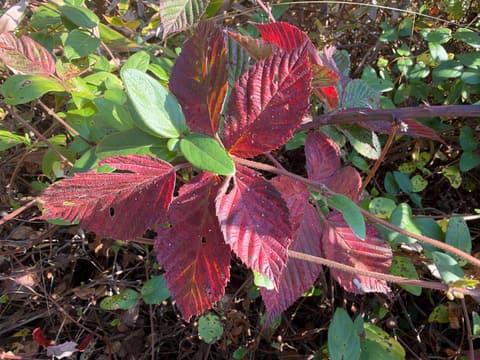
American red raspberry is the wild native subspecies of red raspberry, not the garden raspberry. Garden raspberries are named varieties of this plant, of the European subspecies or of crosses between the two. Its canes bristle with gland-tipped hairs and sharp prickles, and the old bark peels. It is among the first shrubs to fill clearings after logging or fire, and its seed can wait in the soil for decades. It has been used to hold soil on road cuts and other bare ground. Set it in a narrow row along a sunny fence for wild berries and bird cover.
Size, growth and what to expect
American red raspberry grows at a medium pace, about a foot a year in our growth estimator. Its erect to arching canes stand 3 to 6 feet tall, and a patch spreads 3 to 9 feet across. The roots live for years, while each cane lives two summers. A wild patch often fades within 5 to 12 years as trees close over it.
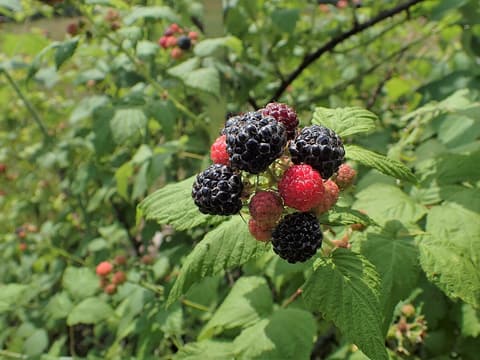
Small white flowers open in loose clusters from May into July. The berries ripen in July and August, red, soft and sweet, and they come off the core as a hollow cup. Songbirds, black bears, coyotes, foxes, raccoons and small mammals eat them.
It grows wild across Canada and Alaska and south in the East to the mountains of North Carolina and Tennessee. In the West it reaches south through the mountains to New Mexico, Arizona and California. It lives in clearings, burns, old fields, roadsides and woods edges, on stream banks, and on rock slides above timberline. Records from Delaware and Missouri are of plants escaped from gardens. North Carolina lists it as threatened.
How to grow American Red Raspberry
American red raspberry fruits best in full sun and thins out in shade. It grows in most soils, sandy loam to silty clay, if they drain well and stay moist, and wet ground rots the roots. It spreads by suckers from its roots and soon fills a patch, so keep it to a row about a foot wide by pulling the strays. Keep it away from a patch of garden raspberries or blackberries, since wild brambles nearby can bring diseases into the patch. Set plants 3 feet apart, and keep each one 4 feet from a wall. It is small enough to stand within 15 feet of overhead wires.
Saplings ship bare-root or potted. Plant them in early spring while they are still dormant, in a hole wide enough to spread the roots and at the depth they grew. Put the native soil back in, firm it gently, and water it well. Sow the cleaned seed outdoors in late summer, an eighth of an inch deep. For spring, hold the seed damp and warm for 90 days, then in the refrigerator for 90 days first. Seedlings come up in spring, some not until the second. Most plants are raised from suckers or divisions, since seed is slow and uneven to sprout. Seed-grown plants vary in the size and flavor of their berries, and none comes true to a named garden variety.
Water weekly from flowering until the harvest when rain is short. Rabbits eat the canes in winter, so circle young plants with chicken wire. After the harvest, cut the canes that fruited to the ground. Thin the new canes to four or five strong ones per foot of row, and tie them to a support.
Wild red raspberry almost always needs pollen from another plant to set fruit, so plant two or more from different seed for a crop. A patch spread from one root counts as one plant. Bees do most of the pollinating, with help from flies and beetles. Each cane bears in its second summer and then dies, so a seedling first fruits in its second year. Anthracnose, gray mold and root rot can be serious diseases. Cane borers and crown borers are its most serious insects.
Heights and zones are typical ranges for the species in cultivation; local conditions and seed source shift them.
Sources (15)
- NC State Extension Gardener Plant Toolbox: Rubus idaeus subsp. strigosus
- Lady Bird Johnson Wildflower Center: Rubus idaeus ssp. strigosus
- Flora of North America, Volume 9: Rubus idaeus subsp. strigosus (Alice, Goldman, Macklin and Moore)
- USDA Forest Service, Fire Effects Information System: Rubus idaeus (Tirmenstein 1990)
- Virginia Tech Dendrology: raspberry
- Missouri Botanical Garden Plant Finder: Rubus idaeus
- Native Plant Trust, Go Botany: Rubus idaeus
- Missouri Department of Conservation Field Guide: Black raspberry
- Trees and Shrubs Online: Rubus idaeus var. strigosus, from Bean
- USDA Forest Service, Woody Plant Seed Manual (Agriculture Handbook 727, 2008): Rubus, blackberry, raspberry
- University of Minnesota Extension: Growing raspberries in the home garden
- North Carolina Natural Heritage Program: 2024 Rare Plant List, revised 11/03/2025
- Virginia Department of Conservation and Recreation: Natural Heritage Resources of Virginia: Rare Plants, September 2026
- NatureServe Explorer: Rubus idaeus ssp. strigosus
- USDA NRCS PLANTS Database: Rubus idaeus ssp. strigosus
Plan the planting
Check your site for it What to plant with it How big, how fast How much to water How to sow it How many for a crop When it flowers and fruits When to plant it where you live How far from the house and wires How old is yours
Read before planting
- Ten planting mistakes that quietly kill trees
- Transplanting young trees: timing, water and protection
- Protecting young trees from voles, rabbits, deer and squirrels
- The habitat around a tree is part of the tree
- What a young tree looks like: first-year seedlings of oak, walnut, hickory, chestnut, maple and redbud, and the weed trees to pull
- Invasive vines and shrubs are what is killing your woods
Other brambles (Rubus) we grow: Allegheny Blackberry and Black Raspberry.
Grows in the same conditions
Plants that share its sun and soil
Trees to plant it under: American Elm, Common Hackberry and Slippery Elm.
More like this