Photo: Wasrts, CC BY-SA 3.0, cropped · Wikimedia Commons
Riverbank Grape
Scientific name: Vitis riparia
Also called frost grape, river grape.
A hardy native grape vine that climbs by tendrils along streams and fences, with fragrant spring flowers and tart blue-black grapes for birds and jelly.
Be first when riverbank grape is priced
Saplings ship bare-root or in a pot, usually 12 to 18 inches tall, in the dormant season, and their height and age are stated here with the price, once available.
We grow it as saplings and seed. One email when it is listed with prices, and nothing else. Or ask, and we reply with what is ready now. Live plants ship February to May and October to November.
Limited timeSign up now and get 10% off when it is ready.
Share: copy link
Riverbank Grape at a glance
- Type
- Shrub
- Mature height
- 35–75 ft
- USDA zones
- 2–9
- Growth rate
- Fast
- Flowers
- May to June
- Fruit
- Berries, July to October
- First crop
- About 3 years after planting
- Mature spread
- 20 ft
- Sun
- Full, Part, Shade
- Soil moisture
- Dry, Average, Wet
- Grows wild in
- Stream banks, floodplain forests, old fields and edges
- Native range
- 34 states and the District of Columbia, north to North Dakota, south to Louisiana and west to Montana Also recorded, not native, in Oregon and Washington. See what is native in your state
List all 35
Arkansas, Colorado, Connecticut, Illinois, Indiana, Iowa, Kansas, Kentucky, Louisiana, Maine, Maryland, Massachusetts, Michigan, Minnesota, Missouri, Montana, Nebraska, New Hampshire, New Jersey, New York, North Carolina, North Dakota, Ohio, Oklahoma, Pennsylvania, Rhode Island, South Dakota, Tennessee, Texas, Vermont, Virginia, West Virginia, Wisconsin, Wyoming and the District of Columbia
Riverbank grape is a wild grape of stream banks and floodplain woods across much of eastern and central North America. It climbs by branched tendrils, so it needs a fence, an arbor or a tree to grip. Its roots resist the grape phylloxera, and it was one of the native grapes whose rootstocks rescued Europe's vineyards from that pest in the late 1800s. Grow it on a sturdy arbor or fence in full sun, where its grapes ripen best.
Size, growth and what to expect
Riverbank grape grows fast, nearly three feet a year in our growth estimator, and it is long-lived. Its vines climb 35 to 75 feet into trees or sprawl over thickets and fences. The leaves are 4 to 6 inches long, heart-shaped with three shallow lobes and coarse teeth, and the bark shreds into reddish brown strips.
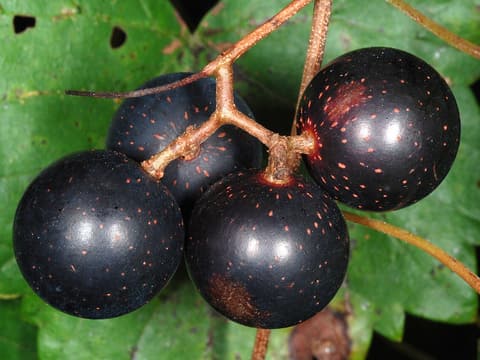
Small, fragrant, yellow-green flowers open in May and June. Clusters of blue-black grapes with a white bloom, a quarter to half an inch across, ripen from July into September and hang into fall. Catbirds, cardinals, bobwhite, ruffed grouse, wild turkeys, raccoons, foxes and deer eat them, and songbirds weave the shredded bark into their nests.
It grows wild from Nova Scotia and Quebec west to Manitoba and Montana, and south to North Carolina, Tennessee, Louisiana and Texas. It lives on stream and river banks, pond margins and floodplain woods, and along fencerows and roadsides. It has also gone wild from plantings in Oregon and Washington.
How to grow Riverbank Grape
Riverbank grape fruits best in full sun and grows in part shade, where it is easier to keep in check. It grows in most soils, acid or limy, moist or fairly dry. It stands flooding along streams. It climbs by tendrils, so give it a sturdy arbor, a fence or a trellis to grip. Keep it off ornamental trees and shrubs, which it can smother with shade or girdle. Set the support 6 feet from a wall, and set plants 12 feet apart along it. It burns readily, so where wildfire is a risk keep it out of the planting zone next to a house. It climbs whatever it reaches, so keep it more than 50 feet from overhead wires.
Saplings ship bare-root or potted. Plant them dormant, from leaf fall until bud swell, in a hole wider than the roots and no deeper. Set the crown at the soil line, put the native soil back in, and keep the mulch clear of the stems. Tie the first shoots to the support until the tendrils take hold. Strip the ripe grapes from the vine, and wash the seed clean of the pulp. For a spring sowing, hold the seed damp in the refrigerator for 3 to 4 months first. It is most often raised from dormant hardwood cuttings, and seed can be slow to start.
Water weekly through the first summer if rain is short. Cut it back as needed to keep it on its support, since it can turn aggressive in full sun. Deer browse the leaves, so cage young vines where deer are many.
Vines are male or female, and only females bear grapes, so plant three or more seedlings for a male and a female. Bees carry the pollen. Japanese beetles can badly damage the leaves, and aphids, leafhoppers, mites, scale insects, leaf galls and powdery mildew also turn up. The grapes stay sour until frost sweetens them, and they make good jelly or wine. Other vines with similar fruit are poisonous, so be sure of the plant before eating its grapes.
Heights and zones are typical ranges for the species in cultivation; local conditions and seed source shift them.
Sources (9)
- NC State Extension Gardener Plant Toolbox: Vitis riparia
- Lady Bird Johnson Wildflower Center: Vitis riparia
- Missouri Department of Conservation Field Guide: Riverbank grape
- Flora of North America, Volume 12: Vitis riparia (Moore and Wen)
- University of Minnesota, Urban Forestry Outreach and Research: River bank grape, Vitis riparia
- USDA Forest Service, Woody Plant Seed Manual (Agriculture Handbook 727, 2008): Vitis labrusca, fox grape (Bonner)
- Louisiana State University School of Renewable Natural Resources, Louisiana Plant ID: river grape
- NatureServe Explorer: Vitis riparia
- USDA NRCS PLANTS Database: Vitis riparia
Plan the planting
Check your site for it What to plant with it How big, how fast How much to water How to sow it How many for a crop When it flowers and fruits When to plant it where you live How far from the house and wires How old is yours
Read before planting
- Ten planting mistakes that quietly kill trees
- Transplanting young trees: timing, water and protection
- Protecting young trees from voles, rabbits, deer and squirrels
- A native food forest: the layers and the species
- The habitat around a tree is part of the tree
- What a young tree looks like: first-year seedlings of oak, walnut, hickory, chestnut, maple and redbud, and the weed trees to pull
Other grapes (Vitis) we grow: Muscadine.
Grows in the same conditions
Plants that share its sun and soil
Trees to plant it under: Slippery Elm, Sugarberry and American Elm.
More like this