Photo: Douglas Goldman, CC BY-SA 4.0, cropped · Wikimedia Commons
Muscadine
Scientific name: Vitis rotundifolia
Also called muscadine grape, scuppernong, southern fox grape, bullace, Muscadinia rotundifolia.
The South's native grape vine, with thick-skinned purple-black or bronze grapes in late summer and fall for eating fresh, jelly, wine and wildlife.
Be first when muscadine is priced
Saplings ship bare-root or in a pot, usually 12 to 18 inches tall, in the dormant season, and their height and age are stated here with the price, once available.
We grow it as saplings and seed. One email when it is listed with prices, and nothing else. Or ask, and we reply with what is ready now. Live plants ship February to May.
Limited timeSign up now and get 10% off when it is ready.
Share: copy link
Muscadine at a glance
- Type
- Shrub
- Mature height
- 30–90 ft
- USDA zones
- 5–9
- Growth rate
- Fast
- Flowers
- April to June
- Fruit
- Berries, August to October
- First crop
- About 3 years after planting
- Mature spread
- 20 ft
- Sun
- Full, Part
- Soil moisture
- Dry, Average
- Grows wild in
- Dry uplands, floodplain forests, sandy barrens and the coast
- Native range
- 17 states, north to Delaware, south to Florida and west to Texas See what is native in your state
List all 17
Alabama, Arkansas, Delaware, Florida, Georgia, Kentucky, Louisiana, Maryland, Mississippi, Missouri, North Carolina, Oklahoma, South Carolina, Tennessee, Texas, Virginia and West Virginia
Muscadine is the native grape vine of the Southeast, the first native grape cultivated in North America and the parent of hundreds of named varieties. Its tendrils are simple rather than forked, its bark stays tight instead of shredding, and it climbs high into trees or sprawls over thickets. Bronze muscadines are often called scuppernongs, after the first named variety, found near the Scuppernong River in North Carolina. It resists Pierce's disease and the phylloxera that keep bunch grapes from thriving in much of the South. Train it on a wire trellis or a sturdy arbor in full sun.
Size, growth and what to expect
Muscadine grows fast, nearly three feet a year in our growth estimator, and in three years a planted vine can cover 6 feet by 15. Wild vines climb 30 to 90 feet into the treetops, and a vine may live for decades.
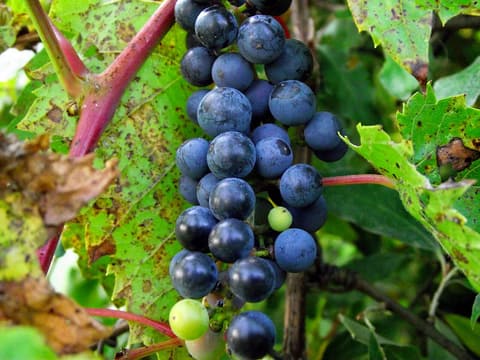
Small, greenish flowers open from late April into June. Its grapes come singly or in small, loose clusters, half an inch to an inch across, purple-black or sometimes bronze, with thick, tough skins and up to five hard seeds. The grapes ripen from August into October and drop when ripe, and birds, deer, wild turkeys, raccoons, foxes and black bears eat them. People eat them fresh or make them into jelly, juice and wine.
It grows wild from Delaware south to Florida and west along the Gulf Coast to eastern Texas, and up the Mississippi valley to Missouri and Kentucky. It lives in upland and lowland woods, swamps, thickets, forest edges, hammocks and dunes. At the north edge of its range it is rare, critically imperiled in Missouri and unconfirmed for decades in West Virginia.
How to grow Muscadine
Muscadine fruits best in full sun, and shade for more than a few hours a day cuts the crop. It wants deep, well-drained, slightly acid soil, and it fails where water stands even briefly after rain or over a hardpan. Once established it is quite drought tolerant. Winter cold below 0 degrees F injures the vines, and they do best where winters seldom fall below 10 degrees F. Give it a single wire 5 to 6 feet above the ground or a sturdy arbor, since a vine on a pergola is hard to keep pruned. Set the trellis 10 feet from a wall, and set vines 20 feet apart along it. It burns readily, so where wildfire is a risk keep it out of the planting zone next to a house. It climbs whatever it reaches, so keep it more than 50 feet from overhead wires.
Saplings ship bare-root or potted. Plant them in late winter or early spring, once hard freezes are past, in a hole wide enough to spread the roots and at the depth they grew. Set the crown at the soil line, put the native soil back in, and keep the mulch clear of the stem. Cut the new vine back to one stem of two or three buds. Tie the strongest new shoot to a stake and lead it up to the wire. Strip the ripe grapes and wash the seed clean of the pulp. For a spring sowing, hold the seed damp in the refrigerator for 12 weeks first. Seedlings vary and do not come true to a named variety, so named varieties are grown from cuttings.
Water during dry spells for the first two summers, and keep a circle around the vine free of weeds with a coarse bark mulch. Feed young vines lightly, since too much nitrogen at once can kill them. Train an arm along the wire in each direction, aiming to reach the wire the first season and full length the second. Prune hard every winter, cutting each side shoot back to two to four buds, or the vine becomes a tangled, fruitless mass. Deer browse it, though the vine is moderately resistant to them.
Wild vines are male or female, and males outnumber females, so plant three to five seedlings to be sure of a fruiting female. Named varieties with perfect flowers, such as 'Carlos' and 'Noble', fruit alone and pollinate female vines within about 25 feet, but seedlings do not come true to them. Wind and insects carry the pollen. Japanese beetles are the worst insect, and powdery mildew, black rot, bitter rot and leaf spot can strike, though home vines often need no spraying. Trained to a wire, a female vine bears its first grapes in about the third year after planting. Other vines with similar fruit are poisonous, so be sure of the plant before eating its grapes.
Heights and zones are typical ranges for the species in cultivation; local conditions and seed source shift them.
Sources (14)
- NC State Extension Gardener Plant Toolbox: Vitis rotundifolia
- NC State Extension, Horticulture Information Leaflet: Muscadine Grapes in the Home Garden (Poling, Fisk and Hoffmann; 2006, revised 2025)
- University of Florida IFAS Extension, HS763: The Muscadine Grape (Vitis rotundifolia Michx) (Andersen, Sarkhosh, Huff and Breman; revised 2020)
- Clemson Cooperative Extension Home and Garden Information Center, HGIC 1403: Muscadine Grape (revised 2015)
- Lady Bird Johnson Wildflower Center: Vitis rotundifolia
- Virginia Tech Dendrology: muscadine grape
- Flora of North America, Volume 12: Vitis rotundifolia (Moore and Wen)
- Mississippi State University Extension, Publication 2290: Establishment and Production of Muscadine Grapes
- Texas A&M AgriLife Extension, Aggie Horticulture: Muscadine (McEachern and Baker, 1997)
- University of Florida IFAS Extension, Nassau County: Q: What is the name of the vine growing all over my trees? (2017)
- NatureServe Explorer: Vitis rotundifolia
- USDA NRCS PLANTS Database: Vitis rotundifolia
- Missouri Department of Conservation: Missouri Species and Communities of Conservation Concern Checklist, 2024
- West Virginia Division of Natural Resources: Rare Plants tracked by the West Virginia Natural Heritage Program, 4 August 2020
Plan the planting
Check your site for it What to plant with it How big, how fast How much to water How to sow it How many for a crop When it flowers and fruits When to plant it where you live How far from the house and wires How old is yours
Read before planting
- Ten planting mistakes that quietly kill trees
- Transplanting young trees: timing, water and protection
- Protecting young trees from voles, rabbits, deer and squirrels
- A native food forest: the layers and the species
- The habitat around a tree is part of the tree
- What a young tree looks like: first-year seedlings of oak, walnut, hickory, chestnut, maple and redbud, and the weed trees to pull
Other grapes (Vitis) we grow: Riverbank Grape.
Grows in the same conditions
Plants that share its sun and soil
Trees to plant it under: American Persimmon, Pignut Hickory and Mockernut Hickory.
More like this