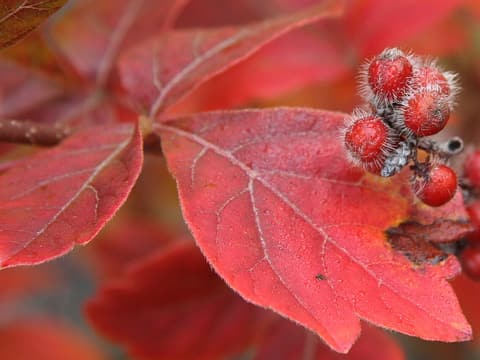
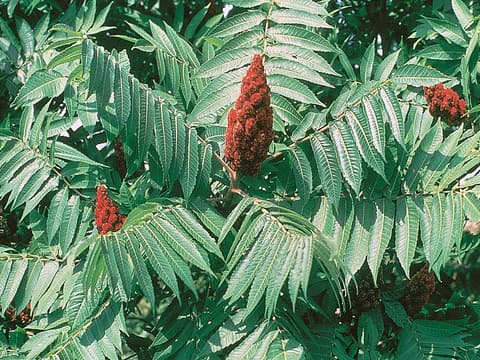
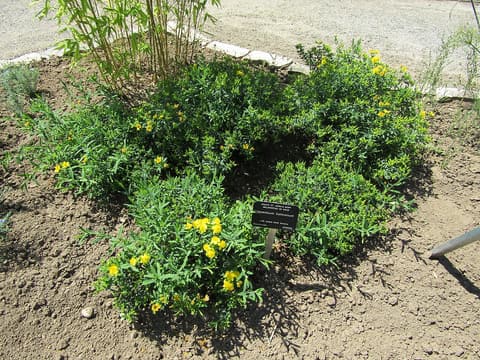
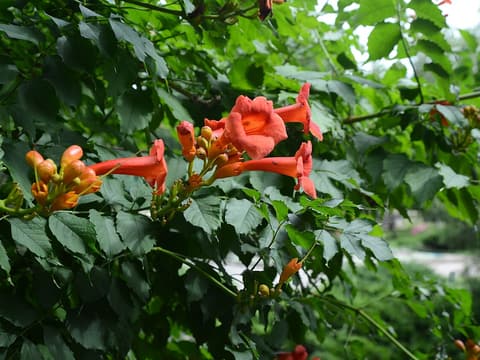
Photo: M. O'Hearn, USDA ARS, Public domain · Wikimedia Commons
American Bittersweet
Scientific name: Celastrus scandens
Also called climbing bittersweet, staff vine, waxwork, false bittersweet.
A native twining vine whose orange capsules split in fall to reveal scarlet seeds that stay showy on the vine into winter.
Be first when American bittersweet is priced
Saplings ship bare-root or in a pot, usually 12 to 18 inches tall, in the dormant season, and their height and age are stated here with the price, once available.
We grow it as saplings and seed. One email when it is listed with prices, and nothing else. Or ask, and we reply with what is ready now. Live plants ship February to May and October to November.
Limited timeSign up now and get 10% off when it is ready.
Share: copy link
American Bittersweet at a glance
- Type
- Shrub
- Mature height
- 15–40 ft
- USDA zones
- 3–8
- Growth rate
- Fast
- Flowers
- May to June
- Fruit
- Capsules, September to January
- First crop
- —
- Mature spread
- 8 ft
- Sun
- Full, Part
- Soil moisture
- Dry, Average
- Grows wild in
- Rocky ground, stream banks, old fields and edges
- Native range
- 38 states and the District of Columbia, north to North Dakota, south to Louisiana and west to Montana See what is native in your state
List all 39
Alabama, Arkansas, Connecticut, Delaware, Georgia, Illinois, Indiana, Iowa, Kansas, Kentucky, Louisiana, Maine, Maryland, Massachusetts, Michigan, Minnesota, Mississippi, Missouri, Montana, Nebraska, New Hampshire, New Jersey, New York, North Carolina, North Dakota, Ohio, Oklahoma, Pennsylvania, Rhode Island, South Carolina, South Dakota, Tennessee, Texas, Vermont, Virginia, West Virginia, Wisconsin, Wyoming and the District of Columbia
American bittersweet is a twining woody vine of thickets, fence rows and woodland edges, and the only bittersweet native to North America. The invasive oriental bittersweet looks much like it, crowds it out and crosses with it. The native bears its flowers and fruit in clusters at the branch tips, and its leaves are about twice as long as wide, with pointed tips. Oriental bittersweet bears small clusters along the stems where the leaves join, and its leaves are nearly round. North Carolina and Rhode Island list it as endangered, and Connecticut lists it as a species of special concern. The fruit hangs on and stays ornamental into winter. Give it a sturdy fence or arbor in full sun, with a male among the females, for fruit to cut for wreaths.
Size, growth and what to expect
American bittersweet grows fast, nearly three feet a year in our growth estimator. It is a twining vine that climbs 15 to 40 feet, and with nothing to climb it sprawls like a shrub. One plant spreads 2 to 8 feet wide, and root suckers can spread it into a thicket.
Small greenish flowers open in May and June, in clusters at the branch tips. Orange capsules about a third of an inch across ripen from late August into October and split to show scarlet-coated seeds. They hang on into midwinter, feeding ruffed grouse, bobwhite quail, wild turkeys, songbirds, fox squirrels and cottontails. The leaves turn yellow in fall.
It grows wild from Maine and southern Quebec west to Manitoba and Montana, and south to Texas and the mountains of Georgia and Alabama. Its home is thickets, woodland edges, fence rows, stream banks and rocky slopes. NatureServe ranks it critically imperiled in Alabama, Louisiana and Texas, at the southern edge of its range.
How to grow American Bittersweet
American bittersweet fruits best in full sun and grows in part shade. It takes most soils that drain well, from sand to clay, and once rooted it rides out drought and road salt. Rich soil lets it outgrow its space, so a lean, dry spot suits it best. Its twining stems cannot grip a flat wall, so give it a sturdy fence, trellis or arbor. Keep it off shrubs and young trees, since its stems can girdle a trunk as it thickens. Stand the support 4 feet from a wall, and set plants 12 feet apart. Keep it at least 15 feet from overhead wires.
Saplings ship bare-root or potted. Plant them dormant, from leaf fall until bud swell, in a hole wider than the roots and no deeper. Set the crown at the soil line, put the native soil back in, and keep the mulch clear of the stems. Pick the fruit once the capsules split, and let it dry for two or three weeks. Sow the cleaned seed outdoors in fall, a quarter inch deep. For spring, hold it damp in the refrigerator for two to six months first.
Water weekly through the first summer and in dry spells until it is established. Rabbits and deer browse the leaves and stems, so cage young plants where they are many. Prune in early spring to keep it in bounds and to bring on fruit.
Vines are male or female, and only females bear fruit, so plant three or more seedlings for a male and a female. One male can serve six to nine females. Bees carry most of the pollen, and wind may carry some. Powdery mildew, crown gall and euonymus scale can show up, and scale can be serious. All parts of the plant are reported to be poisonous, and eating the fruit can cause vomiting and diarrhea.
Heights and zones are typical ranges for the species in cultivation; local conditions and seed source shift them.
Sources (18)
- USDA Forest Service, Woody Plant Seed Manual (2008), Celastrus chapter, Wendel, Barbour and Karrfalt
- NC State Extension Gardener Plant Toolbox: Celastrus scandens
- Lady Bird Johnson Wildflower Center: Celastrus scandens
- The Morton Arboretum: American bittersweet
- Missouri Department of Conservation Field Guide: American bittersweet
- USDA NRCS Plant Guide: American bittersweet, Celastrus scandens, Nesom and Moore 2000
- Flora of North America, vol. 12: Celastrus scandens, Ma and Levin
- Go Botany, Native Plant Trust: Celastrus scandens
- University of Michigan, CLIMBERS: Celastrus scandens, Robyn J. Burnham
- Leicht-Young, Pavlovic, Grundel and Frohnapple 2007, Distinguishing native (Celastrus scandens L.) and invasive (C. orbiculatus Thunb.) bittersweet species using morphological characteristics, Journal of the Torrey Botanical Society 134: 441-450
- University of Tennessee Institute of Agriculture, Tennessee Smart Yards: Celastrus scandens
- NC State Extension Gardener Plant Toolbox: Celastrus orbiculatus
- NatureServe Explorer: Celastrus scandens
- North Carolina Natural Heritage Program: List of Rare Plant Species of North Carolina 2024, revised 11/03/2025
- Rhode Island Natural History Survey: Rhode Island Rare Plants 2016
- Connecticut Department of Energy and Environmental Protection: Endangered, Threatened and Special Concern Plants, effective August 5, 2015
- Montana Natural Heritage Program, Montana Field Guide: Bittersweet, Celastrus scandens
- USDA NRCS PLANTS Database: Celastrus scandens
Plan the planting
Check your site for it What to plant with it How big, how fast How much to water How to sow it How many for a crop When it flowers and fruits When to plant it where you live How far from the house and wires How old is yours
Read before planting
- Ten planting mistakes that quietly kill trees
- Transplanting young trees: timing, water and protection
- Protecting young trees from voles, rabbits, deer and squirrels
- The habitat around a tree is part of the tree
- What a young tree looks like: first-year seedlings of oak, walnut, hickory, chestnut, maple and redbud, and the weed trees to pull
- Invasive vines and shrubs are what is killing your woods
Grows in the same conditions
Plants that share its sun and soil
Trees to plant it under: Common Hackberry, Western Soapberry and Winged Elm.
More like this