Photo: U.S. Fish and Wildlife Service, Public domain · Wikimedia Commons
American Hazelnut
Scientific name: Corylus americana
Also called American filbert.
Sweet native filberts in late summer on a dense, easy hedgerow shrub.
Be first when American hazelnut is priced
Saplings ship bare-root, usually 12 to 18 inches tall, in the dormant season, and their height and age are stated here with the price, once available.
We grow it as saplings and nuts. One email when it is listed with prices, and nothing else. Or ask, and we reply with what is ready now. Live plants ship February to May and October to November.
Limited timeSign up now and get 10% off when it is ready.
Share: copy link
American Hazelnut at a glance
- Type
- Shrub
- Mature height
- 8–12 ft
- USDA zones
- 4–9
- Growth rate
- Medium
- Flowers
- February to April
- Fruit
- Nuts, September to October
- First crop
- 2 to 3 years
- Mature spread
- 13 ft
- Sun
- Full, Part
- Soil moisture
- Dry, Average
- Grows wild in
- The forest understory, dry uplands, old fields and edges
- Native range
- 35 states and the District of Columbia, north and west to North Dakota and south to Louisiana See what is native in your state
List all 36
Alabama, Arkansas, Connecticut, Delaware, Georgia, Illinois, Indiana, Iowa, Kansas, Kentucky, Louisiana, Maine, Maryland, Massachusetts, Michigan, Minnesota, Mississippi, Missouri, Nebraska, New Hampshire, New Jersey, New York, North Carolina, North Dakota, Ohio, Oklahoma, Pennsylvania, Rhode Island, South Carolina, South Dakota, Tennessee, Vermont, Virginia, West Virginia, Wisconsin and the District of Columbia
American hazelnut resists the eastern filbert blight that kills European hazels, and it bears small, sweet nuts within a few years. It suckers into a broad thicket, turns orange-red in fall, and feeds turkeys, grouse and squirrels. Plant two or more for cross-pollination and net the bushes if you want any nuts yourself. Best used as a thick property-line hedge or the shrub row of a windbreak.
Size, growth and what to expect
A young American hazelnut adds 13 to 24 inches of height a year. That matches the roughly foot and a half a year our growth estimator uses for a medium grower. It makes a rounded, thicket-forming shrub, 8 to 12 feet tall and 8 to 13 feet wide, and it is long-lived.
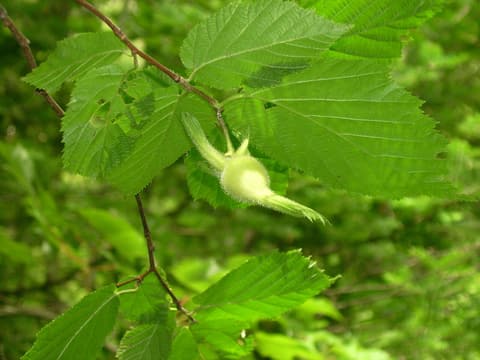
Nuts usually start on plants 2 to 3 years old, with a good crop every 2 to 3 years. The male catkins, 2 to 4 inches long, open in late winter or early spring before the leaves. The half-inch brown nuts ripen from September to October inside a hairy husk with ragged edges. Grouse, quail, wild turkeys, chipmunks, squirrels, foxes, black bears and deer eat them. Hazel is an old English word for filbert.
It grows wild from Maine west to Saskatchewan and south to eastern Oklahoma and Georgia, along streams, in hedgerows, meadows and woodland margins.
How to grow American Hazelnut
American hazelnut grows in full sun or part shade, on any soil from dry sand to average loam as long as it drains. It suckers into a wide clump, so plant hedgerow bushes 6 to 8 feet apart and keep single plants 10 feet from paths and buildings.
Bare-root saplings go in while dormant, late fall or early spring. Dig a hole twice the width of the roots, keep the root flare at grade, and backfill with plain soil. Mulch two or three inches deep in a ring that stays off the stems. Nuts are sown in fall, two inches deep, and must be covered with hardware cloth, since squirrels and chipmunks dig them up.
Water once a week through the first summer. Rabbits and voles chew young hazel stems, and deer nip the tips, so cage the bush for the first two or three years. No pruning is needed beyond removing dead wood.
Hazelnuts are wind-pollinated and a single bush will not set nuts, so plant two or more seedlings within 50 feet. Squirrels and blue jays take the crop early, so pick when the husks begin to brown.
Heights and zones are typical ranges for the species in cultivation; local conditions and seed source shift them.
Sources (14)
- USDA Fire Effects Information System: Corylus americana
- NC State Extension Gardener Plant Toolbox: Corylus americana
- The Morton Arboretum: American hazelnut
- USDA NRCS Plant Guide: American hazelnut, Corylus americana
- USDA Forest Service, Woody Plant Seed Manual: Corylus chapter
- Lady Bird Johnson Wildflower Center: Corylus americana
- Virginia Tech Dendrology: American hazel, Corylus americana
- NatureServe Explorer: Corylus americana
- Flora of North America, vol. 3: Corylus americana
- Go Botany (Native Plant Trust): Corylus americana, American hazelnut
- Trees and Shrubs Online: Corylus americana
- University of Wisconsin-Madison Extension, Wisconsin Horticulture: Eastern filbert blight
- The American Heritage Dictionary of the English Language, 5th edition: hazel
- USDA NRCS PLANTS Database: Corylus americana
Plan the planting
Check your site for it What to plant with it How big, how fast How much to water How to sow it How many for a crop When it flowers and fruits When to plant it where you live How far from the house and wires How old is yours
Read before planting
- Ten planting mistakes that quietly kill trees
- Transplanting young trees: timing, water and protection
- Protecting young trees from voles, rabbits, deer and squirrels
- Native fruit and nut trees to grow and eat: what each bears, when it starts, and which need a partner
- Native hedges, screens and windbreaks: which trees to use and how far apart to set them
- The habitat around a tree is part of the tree
Other hazelnuts (Corylus) we grow: Beaked Hazelnut.
Grows in the same conditions
Plants that share its sun and soil
Trees to plant it under: Slippery Elm, Hop Hornbeam and Black Cherry.
More like this