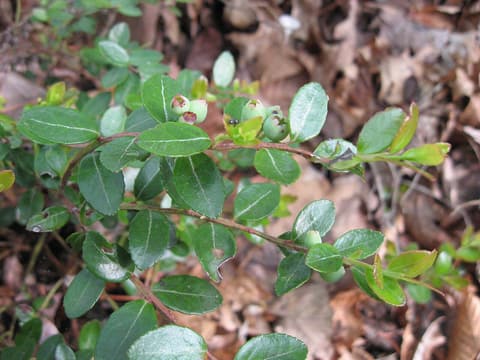
Photo: Alex Abair, CC BY 4.0, cropped · Wikimedia Commons
Eastern Teaberry
Scientific name: Gaultheria procumbens · Family: Ericaceae (heath family)
Also called wintergreen, checkerberry, teaberry, American wintergreen, boxberry, mountain tea.
An evergreen groundcover for acid shade, with glossy leaves that smell of wintergreen and red berries that often hang on through the winter.
Be first when eastern teaberry is priced
Saplings ship bare-root or in a pot, in the dormant season, and their height and age are stated here with the price, once available.
We grow it as saplings and seed. One email when it is listed with prices, and nothing else. Or ask, and we reply with what is ready now. Live plants ship February to May and October to November.
Limited timeSign up now and get 10% off when it is ready.
Share: copy link
Eastern Teaberry at a glance
- Type
- Shrub
- Mature height
- 1 ft
- USDA zones
- 3–8
- Growth rate
- Slow
- Flowers
- June to August
- Fruit
- Berries, September to February
- First crop
- —
- Mature spread
- 1 ft
- Sun
- Part, Shade
- Soil moisture
- Dry, Average
- Grows wild in
- The forest understory, sandy barrens, dry uplands and the Appalachians
- Native range
- 25 states and the District of Columbia, north and west to Minnesota and south to Georgia See what is native in your state
List all 26
Alabama, Connecticut, Delaware, Georgia, Illinois, Indiana, Kentucky, Maine, Maryland, Massachusetts, Michigan, Minnesota, New Hampshire, New Jersey, New York, North Carolina, Ohio, Pennsylvania, Rhode Island, South Carolina, Tennessee, Vermont, Virginia, West Virginia, Wisconsin and the District of Columbia
Eastern teaberry is a creeping evergreen of the heath family, and its crushed leaves and red berries smell and taste of wintergreen. Its upright stems rise a few inches from runners that creep underground through the leaf mold of oak and pine woods. In winter its leaves are among the few green ones in the woods, and chipmunks, grouse, mice and deer eat them. Mass it under oaks, pines or rhododendrons on acid soil, where it slowly spreads into a dense, glossy carpet.
Size, growth and what to expect
It grows slowly, a few inches a year in our growth estimator. Its stems stand 3 to 8 inches tall, and a plant spreads 6 inches to a foot across. The glossy, leathery leaves are 1 to 2 inches long, and they turn purplish or reddish in cold weather.
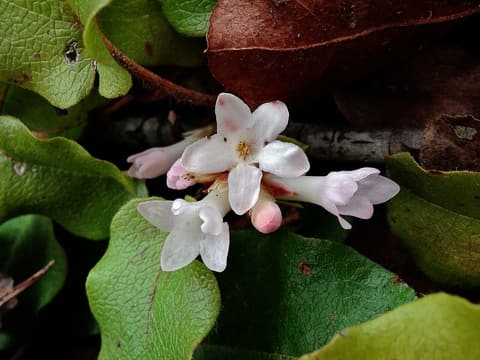
Small, waxy white bells, sometimes tinged pink, nod beneath the leaves from June to August. The bright red berries, about a third of an inch across, ripen from September and often hang on through the winter. Grouse, pheasants, wild turkeys, chipmunks, foxes and black bears all eat teaberry, and the eastern chipmunk favors it.
It grows wild from Newfoundland and Manitoba south to Minnesota, Tennessee and Virginia, and in the mountains to Georgia and Alabama. Its home is acid woods of oak or pine, clearings, heath balds and the edges of bogs, usually on sandy or peaty soil.
How to grow Eastern Teaberry
Eastern teaberry grows in part shade or shade, and it flowers and fruits best in light shade or a small opening. It needs an acid soil rich in organic matter that stays evenly moist but drains, and it does not take lime. Established plants stand some dryness, and it does best where summers are cool. Set plants 2 feet apart, or a foot apart for a quicker carpet, and keep them 2 feet from a wall. At its size it can go within 15 feet of overhead wires.
Saplings ship bare-root or potted. Plant them in spring or fall, in a hole wider than the roots and no deeper. Set the crown at the soil line, put the native soil back in, and keep the mulch ring clear of the stems. Sow the fine seed on the surface of a damp, acid mix in fall or early winter, and do not cover it. For spring, hold the damp seed in the refrigerator for 30 to 75 days first. Seed left unchilled is slow to come up, and even chilled seed comes up sparsely.
Water it every day for the first two weeks after planting, then every two to three days until week 12. After that, water weekly through the first two summers, since its roots lie within an inch of the surface. Once it is settled, thin the branches that shade it heavily, since more light brings more flowers and berries.
Bumblebees work the flowers, and a single plant can set fruit with its own pollen. No serious pests or diseases trouble it, though aphids, thrips, mildew and leaf spot turn up at times. The berries are edible raw or cooked, but tea from the leaves is no longer recommended. Oil of wintergreen, once made from the leaves, is methyl salicylate, and as little as 4 milliliters of it may be fatal to a child.
Heights and zones are typical ranges for the species in cultivation; local conditions and seed source shift them.
Sources (10)
- NC State Extension Gardener Plant Toolbox: Gaultheria procumbens
- Missouri Botanical Garden Plant Finder: Gaultheria procumbens
- Lady Bird Johnson Wildflower Center: Gaultheria procumbens
- USDA Forest Service, Fire Effects Information System: Gaultheria procumbens, Coladonato 1994
- USDA Forest Service, Woody Plant Seed Manual (2008), Gaultheria chapter, Huffman, Zasada and Stein
- Flora of North America, vol. 8: Gaultheria procumbens
- Go Botany (Native Plant Trust): Gaultheria procumbens, eastern spicy-wintergreen
- Native Plant Network: propagation protocol for Gaultheria procumbens, Baskin and Baskin 2001
- PubChem, National Library of Medicine: Methyl salicylate, CID 4133
- NatureServe Explorer: Gaultheria procumbens
Plan the planting
Check your site for it What to plant with it How big, how fast How much to water How to sow it How many for a crop When it flowers and fruits When to plant it where you live How far from the house and wires How old is yours
Read before planting
- Ten planting mistakes that quietly kill trees
- Transplanting young trees: timing, water and protection
- Protecting young trees from voles, rabbits, deer and squirrels
- Low native shrubs and groundcovers for sun, shade, sand and bog
- The habitat around a tree is part of the tree
- What a young tree looks like: first-year seedlings of oak, walnut, hickory, chestnut, maple and redbud, and the weed trees to pull
Grows in the same conditions
Plants that share its sun and soil
Trees to plant it under: Hop Hornbeam, Sourwood and Northern Red Oak.
More like this