Photo: Blue Whale Trees
Black Elderberry
Scientific name: Sambucus canadensis
Also called American elderberry, common elderberry, Sambucus nigra ssp. canadensis.
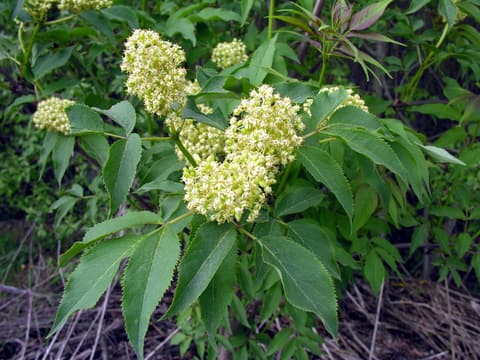
Broad white flower plates in June, purple-black berries in August, and a magnet for dozens of bird species.
Be first when black elderberry is priced
Saplings ship bare-root, usually 12 to 18 inches tall, in the dormant season, and their height and age are stated here with the price, once available.
We grow it as saplings and seed. One email when it is listed with prices, and nothing else. Or ask, and we reply with what is ready now. Live plants ship February to May and October to November.
Limited timeSign up now and get 10% off when it is ready.
Share: copy link
Black Elderberry at a glance
- Type
- Shrub
- Mature height
- 6–12 ft
- USDA zones
- 3–9
- Growth rate
- Fast
- Flowers
- June to August
- Fruit
- Berries, July to September
- First crop
- 2 years (first flowers, on canes in their second year)
- Mature spread
- 12 ft
- Sun
- Full, Part
- Soil moisture
- Average, Wet
- Grows wild in
- Stream banks, old fields and edges
- Native range
- 43 states and the District of Columbia, north to North Dakota, south to Florida and west to California Also recorded, not native, in Hawaii. See what is native in your state
List all 44
Alabama, Arizona, Arkansas, California, Colorado, Connecticut, Delaware, Florida, Georgia, Illinois, Indiana, Iowa, Kansas, Kentucky, Louisiana, Maine, Maryland, Massachusetts, Michigan, Minnesota, Mississippi, Missouri, Montana, Nebraska, New Hampshire, New Jersey, New Mexico, New York, North Carolina, North Dakota, Ohio, Oklahoma, Pennsylvania, Rhode Island, South Carolina, South Dakota, Tennessee, Texas, Vermont, Virginia, West Virginia, Wisconsin, Wyoming and the District of Columbia
American elderberry grows fast in wet ditches, sunny edges and ordinary garden soil. The cooked berries make syrup, wine and pie; the flowers make cordial. Raw berries and all green parts are mildly toxic, so cook the fruit. Beside streams and ponds it holds moist soil against erosion. At home along a soggy fence line, as a fast informal screen that feeds the birds.
Size, growth and what to expect
Black elderberry starts slowly and then runs. The USDA fact sheet says seedling growth is rather slow in the first year, after which established plants soon outdistance the weeds. After that it is a fast grower, and our growth estimator gives it nearly three feet a year in its youth on an average site. It makes an erect, thicket-forming shrub 6 to 12 feet tall and usually wider than tall, spreading by root suckers.
Flowers form on canes in their second year. Fragrant creamy white flowers open from June into August in flat heads 4 to 10 inches across, and the purple-black berries ripen from late July into September. Each berry is under a quarter inch across with 3 to 5 small seeds and crimson juice. At least 50 kinds of songbirds, game birds and small mammals relish the fruit, and the thickets make outstanding nesting cover for small birds.
It grows wild across the eastern and midwestern United States and southeastern Canada, along streams and in the bottomlands beside them.
How to grow Black Elderberry
Black elderberry grows in full sun or part shade, on average to wet soil. A damp ditch or a low sunny corner suits it, and fruit sets heaviest in sun. It suckers into a colony, so allow 6 to 8 feet between plants and keep it 10 feet from walls and paths.
Plant bare-root saplings while dormant, fall through early spring. Dig a hole twice the width of the roots, no deeper, with the root flare at grade, and backfill with the native soil. Mulch a ring three inches deep, kept off the canes. Seed needs a warm spell and then a winter. Clean it from the pulp and sow it outdoors in fall a quarter inch deep, and seedlings come up the second spring. For a spring sowing, keep it in a damp bag for two months at room temperature and then three to five months in the refrigerator.
Elderberry roots are shallow, so water twice a week in its first summer if the ground dries. Rabbits chew young canes and deer browse the foliage, so cage the plant for the first two years. From the third winter on, remove dead canes and any cane older than three years, or cut the whole bush to the ground every few years.
Elderberry is partly self-fertile, but two seedlings set more fruit. Birds strip the berries as they ripen in August, so net if you want a crop. Cook the fruit before eating it, and leave the leaves and stems alone; both are toxic.
Heights and zones are typical ranges for the species in cultivation; local conditions and seed source shift them.
Sources (12)
- USDA NRCS Plant Fact Sheet: American elder, Sambucus nigra ssp. canadensis
- University of Florida IFAS: Sambucus nigra ssp. canadensis, ENH-736/ST578
- NC State Extension Gardener Plant Toolbox: Sambucus canadensis
- USDA NRCS PLANTS Database: Sambucus nigra
- USDA Forest Service, Woody Plant Seed Manual: Sambucus chapter
- Lady Bird Johnson Wildflower Center: Sambucus nigra ssp. canadensis
- Virginia Tech Dendrology: American elderberry, Sambucus nigra ssp. canadensis
- Go Botany (Native Plant Trust): Sambucus nigra, black elderberry
- Trees and Shrubs Online: Sambucus canadensis
- The Morton Arboretum: common elderberry
- Missouri Botanical Garden Plant Finder: Sambucus canadensis
- Iowa State University Extension and Outreach, Natural Resources: Elderberry
Plan the planting
Check your site for it What to plant with it How big, how fast How much to water How to sow it How many for a crop When it flowers and fruits When to plant it where you live How far from the house and wires How old is yours
Read before planting
- Ten planting mistakes that quietly kill trees
- Transplanting young trees: timing, water and protection
- Protecting young trees from voles, rabbits, deer and squirrels
- Native hedges, screens and windbreaks: which trees to use and how far apart to set them
- Which native nuts and fruit poison dogs, horses and children, and which are food
- The habitat around a tree is part of the tree
Other elderberries (Sambucus) we grow: Red Elderberry.
Grows in the same conditions
Plants that share its sun and soil
Trees to plant it under: American Elm, Slippery Elm and Sugarberry.
More like this